

What to Look for in a Service Level Agreement (SLA) When Hiring an MSP

A Service Level Agreement defines how a business and its Managed Service Provider (MSP) work together. It establishes expectations, responsibilities and measurable performance standards that guide the relationship over time. A well-structured SLA sets the tone for accountability, transparency and trust, helping both parties understand exactly how services are delivered and evaluated.
How Service Level Agreements (SLAs) Work in MSP Contracts
A Service Level Agreement is a contract between a business and its MSP that defines the scope of services and responsibilities for both parties. SLAs set clear expectations for service delivery and establish measurable benchmarks the MSP must meet. When written correctly, an SLA prevents misunderstandings by clearly outlining obligations and performance criteria.
What are the Key Components of a Strong SLA?
- Scope of Services
This section defines what services are included, what is excluded and where responsibility boundaries exist. Clear scope alignment ensures both parties understand what support is provided.
- Service Level Objectives (SLOs)
SLOs define measurable objectives such as system uptime, response times and Mean Time to Resolution. These metrics serve as benchmarks for evaluating performance and are commonly reviewed during Quarterly Business Reviews.
- Response Times and Escalation Processes
Incidents are categorized by severity levels, typically P1 through P4. Each level defines response expectations, communication requirements and escalation paths to ensure timely resolution and visibility during outages.
- System Availability and Uptime
SLAs specify the percentage of time services must remain available, often 99.9% or higher. Higher availability targets may be required for industries with strict operational tolerance.
- Support Hours and Availability
This section outlines coverage hours, weekend or holiday support and any additional charges. Explicit definitions help both parties plan availability and manage expectations.
What are the Key Benefits of a Well-Written SLA?
Clear Accountability
Defined metrics and responsibilities create measurable standards for performance and service quality.
Predictable Service Delivery
Response times, escalation paths and uptime commitments reduce uncertainty during incidents.
Improved Communication
Documented reporting and notification processes ensure the right stakeholders are informed at the right time.
Stronger Trust
Transparency around services, pricing and expectations fosters confidence in the MSP partnership.
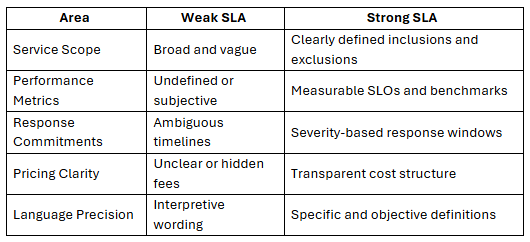
SLA Examples: Strong vs Weak SLA Structures
How to Evaluate an SLA Before Signing?
Strong SLAs define service scope, response timelines, uptime targets, escalation paths, reporting cadence and pricing transparency. Reviewing an SLA carefully before engagement helps prevent future disputes.
- Confirm the scope of services clearly defines responsibilities
- Validate SLOs include uptime, response times and resolution metrics
- Review escalation paths and communication requirements
- Check uptime guarantees align with business dependency levels
- Ensure pricing terms outline all fees and usage conditions
These steps help align expectations and support a durable MSP partnership.
Key Takeaways
- An SLA establishes the foundation for MSP accountability and service quality
- Clear scope definitions prevent misunderstandings
- Measurable objectives support performance evaluation
- Specific language avoids disputes and ambiguity
- Transparent pricing builds trust and predictability
FAQ
What is an SLA?
A Service Level Agreement defines how MSP services are delivered, measured and held accountable over time.
Why are SLAs important in MSP relationships?
SLAs define expectations, responsibilities and performance benchmarks that guide service delivery and accountability.
What metrics should an SLA include?
Common metrics include system uptime, response times, Mean Time to Resolution and escalation requirements.
How do escalation levels improve incident handling?
Severity-based priorities ensure critical issues receive immediate attention while lower-impact issues follow appropriate timelines.
Why should language in an SLA be specific?
Precise language eliminates interpretation gaps and ensures both parties share the same understanding of commitments.
How often should SLA performance be reviewed?
SLA metrics are typically reviewed during Quarterly Business Reviews to assess performance and alignment.
%20(1).png)
Popular reads below:
.png)
How to Transition to a New MSP Without Disruption - The MSP Onboarding Blueprint

.png)
How to Measure MSP Performance (And What Metrics Actually Matter)
.png)
How MSPs Safeguard Businesses Against Modern Cyber Threats

Top 5 Security Mistakes Companies Make Before Hiring an MSP

10 Red Flags That Your MSP Isn’t Delivering True Value

Managed Services vs Break-Fix: How Reactive IT Creates Higher Costs and Operational Strain


